I recently started reading a book by George Saunders called Bilingual Children: From Birth to Teens. The book is full of wonderfully described terms in definitions quite easy to understand by the non-specialist reader. Saunders writes about his family including himself, wife, and three children. The children were raised speaking German and English. He shares their experiences along with other findings of his own and others' research on bilingualism.
"Bilingual families are by no means a rarity in today's world. Indeed, bilingualism is a far more common phenomenon than the predominantly monolingual native speakers of a world language such as English might realize. In fact, bilinguals outnumber monolinguals" (Saunders, 1988, pg. 1). Saunders addresses the fact that there are various levels or degrees of bilingualism and that the word holds different connotations for different people.
A person's level of language can be assessed by the four skills of listening comprehension, speaking, reading comprehension, and writing. The degree of bilingualism would be determined by assessing these skills in both language.
I am by no means a bilingual who could pass as a native speaker, but I do hold a degree of bilingualism.
French, we have a long journey ahead of us. I am extremely jealous of my daughters who have been exposed to two languages since birth. Learning a second language as an adult is proving a challenge for me.
Tuesday, December 30, 2014

Tuesday, May 13, 2014
A trip "home."
Well, I have been in Alabama in the United States of America for one week now. I have to say it hasn't change and it has changed tons. Perhaps it is me who has done the most changing. I have been living in Europe for five years now. It is May, right? Yes, five years. Wow, not so long, but long enough. My little family has become home. I may have some roots and history in Bama, but I belong in Europe or wherever my hubby, our two daughters, and I happen to be. Plus, it just isn't the same, France and the states. I don't have to search for parking and pay here in lower Alabama. I went to a grocery store on Sunday. I cannot find certain things I am now accustomed to in said grocery store. It is not easy to use my own bags due to the cashiers already stuffing my purchases inside plastic bags. Now, just these few examples you may think are pros for the states. Yet, I prefer using my own shopping bags. You don't have to worry about someone smushing your bread or putting cleaning products in with food items. Though it seems American cashiers are getting better. I like that most every store in Metz, France closes at a reasonable hour during the week and only a bakery or two may be opened on Sunday. My husband would disagree with me. He appreciates the idea of being able to go shop at three in the morning with hardly anyone in the store. I have adjusted to the differences in food. I cannot find my normal brands here in the states. Really, KinderSurprise eggs are not allowed in the states. Look them up, you will laugh and want one! Oh, did I mention it is strange to hear English everywhere. It is weird I am just use to hearing French, reading French, conversing in French. I don't have to stop and think about what I am going to say in French here. I think I like being surrounded by French. I am less likely to eavesdrop on people.
Random post which was saved from when I visited the states all by myself.
Random post which was saved from when I visited the states all by myself.
Friday, April 4, 2014
Yep, they're French.
Daft Punk that is.
 |
| Part of a photo shoot for the Wall Street Journal. |
Courtesy of http://www.daftpunk-anthology.com/daft-news
Tuesday, April 1, 2014
Oh when do I stop translating in my head and just speak and comprehend French as French?
This is a big question for me. I am at some what of a stand still with my French learning while I attend online college classes in English. Well, I suppose I only have myself to blame. I make time for two classes a week. Why not French verb drills, vocabulary, flash cards, or some audio listening comprehension on a regular basis. It is very tiring to listen in French to a native French speaker and hope I have time enough to work out in my head what is being said. Then I try to get myself together fast enough again in my head to get my tongue moving and staying in decent timing with the conversation. Sure talking with the same people helps. You get use to a person's voice, his/her nuances, the speed, the style, and best of all he/she knows what to expect from you. When I talk with someone I see once a week or less I have found I am much closer to mental exhaustion after a conversation. I suppose with more time and absolutely with more French studying efforts I will eventually approach fluency. Until then I need a bag of frozen peas for my brain.
Thursday, March 27, 2014
Just thought I would share.
World Endeavors :is a link to a blog site of a company which offers internships and possibly more. I do not know. I found them through Google when I thought I had elective credit hours open to possibly do an internship class. I do not have the availability in my schedule nor does this company offer anything in France at the time. I do find their periodic emails entertaining if not informative. This one containing this blog entry and its 5 Tips to Overcome Culture Shock interested me. Part of why I am blogging is culture shock, so here is someone else's advice on the subject. I concur.
Happy reading.
Happy reading.
Tuesday, March 18, 2014
Principality of Liechtenstein.
Ever heard of Vaduz? Well it is the capitol of one of the smallest countries if not the smallest country. However, in all actuality it is a principality and so being a country is questionable. If you are interested you can check out this tiny place ruled by its Prince and Princess at:
http://www.tourismus.li/en/our-country/about-Liechtenstein.html
or
http://www.infoplease.com/country/liechtenstein.html
 Vaduz Castle
 The Red House

This rich little German speaking place a bit smaller than Washington DC is in Europe, right smack in the middle of the Alps, but is not part of the European Union. So, just so you know, it uses the Swiss Franc, but accepts the Euro...tourism at its finest.
http://www.tourismus.li/en/our-country/about-Liechtenstein.html
or
http://www.infoplease.com/country/liechtenstein.html
Vaduz CastleThe Red House
A little model of Vaduz Castle
This rich little German speaking place a bit smaller than Washington DC is in Europe, right smack in the middle of the Alps, but is not part of the European Union. So, just so you know, it uses the Swiss Franc, but accepts the Euro...tourism at its finest.
Sunday, March 9, 2014
Saturday, March 8, 2014
Script for Culture Shock: Assimilate, Separate, or Integrate
Hello, my name is Pamela. Culture shock, have you ever experienced it? I sure have. I am an American married to a Frenchman. My cultural journey started seven years ago upon meeting my husband. In 2008 I moved to a small French village. In the beginning I did not truly feel the geographic culture shock because I was busy with “first time parent shock.” Staying at home with my newborn aided me in separation from my host culture. Next, I spent three years in Belgium with its three national languages and culturally different regions. These years proved to be more shocking. I contended with more language barriers. I encountered new and different on a regular basis. I missed foods and other everyday items. I missed my Alabama home, family, and friends. I also had my second child. I sought culture shock relief through expensive imported American foods and spending time with America or at least English speaking persons. I still separated, but was willing to partake in culture. Now I have been back in France for roughly a year and a half. Sure, I still miss things about life in Alabama: I miss my native English speaking family and friends; I miss church worship in English; I miss small things like ranch dressing and Tootsie Rolls (care packages from home a great); I miss parking that is easy to come by and free; and I miss stores being open 24/7. Yet, I have adapted, I have integrated, and I have made the choice to replace things when possible or better yet simply move on and accept the change. There are French equivalents or alternatives to most things. Really, though, for a lot of things I have merely forgotten I even missed them. Allow me to share. At first milk was a major shock for me. In France it is homogenized and comes in different fat levels as in the states, but French milk is UHT or sterilized at ultra-high-temperatures. This process kills more germs and allows a liter of milk to sit on a shelf in my garage unrefrigerated until opened, unrefrigerated! Strange, right? The taste was totally bizarre to me, but with time my taste buds changed. Other shocks for me include: des bises greetings, the strong taste of French cheese, comic books resembling porn available at my local grocery store, and everyone having a name day or une fête. I still have to mark my calendar to remember my husband’s day. All of this and more may still seem strange to me, but I have grown accustomed. French and Americans are different, c’est tout! Finally, I am a mother of bilingual children with dual citizenship. With that said, I want my daughters to partake in American culture as well as French. This is challenging if not impossible because well, we are in fact in France. For instance, Americans have the Easter Bunny while the French are visited by Les Cloches de Pâques, or Easter Bells. My daughters know both and expect them both. Americans celebrate Thanksgiving which is non-existent in France and the French have a yummy holiday solely for consuming crêpes known as La Chandeleur. At Thanksgiving I prepare as traditional meal as possible and for Crêpe Day I have learned the art of making crêpes. These are only a few examples. There are plenty of ways I have run into and I continue to run into shock when it comes to culture differences. So, what do you do? Do you assimilate, completely replacing your native culture with a different one? Do you separate yourself and maintain your own culture in a community of liked mined others? Or do you integrate, finding the balance between partaking in the host culture while also maintaining a sense of your native culture? To the best of my abilities along with time I have embraced the differences and have integrated. Let’s say I am Frenchish American now. It is difficult, frustrating, and exciting all at the same time. Regardless, in my opinion it is all about choice and attitude. If you remain positive and welcome change, culture shock can be rewarding and pass quickly. Reminding yourself that the shock you feel is merely the effect of being faced with the new, the different, or the unknown will help you roll with the punches. On the other hand if you are unwillingly to try different or new and you resist the unknown completely there is sure to be difficult long lastly “shock.” Thank you. Aurevoir et a bientout!
Friday, February 28, 2014
Un peu de culture française/A little French culture...that is Belgian!
Gaston Lagaffe celebrates 57 years!
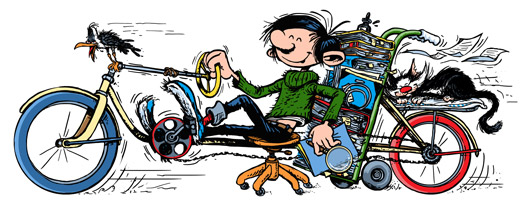
Picture Retrieved from: Google France
This is the drawing for the word Google at the top of the screen for Google France. However, André Franquin is a Belgian comics artist.
He also is responsible for Marsupilami.


Picture retrieved from:http://www.marsupilami.com/insolite/dessin/
You can learn more about Franquin and his comics at: www.franquin.com
Franquin wrote in French, so there you have it. It is popular French culture. My husband grew up reading Gaston Lagaffe. Do you know Gaston? I did not know him until moving to France. He is funny though!
Tuesday, February 25, 2014
Assimilate, Separate, or Integrate? (The Script)
Have you
ever experienced culture shock? My name is Pamela and I sure have. I am an
American married to a Frenchman. I began my cultural journey five years ago in
a small village in the south east of France. I did not I truly feel the
geographic culture shock in the beginning because I was busy with a newborn.
The culture shock of being a mommy helped keep separated me from my host French
culture. I went on to spend three years in Belgium where there are three
national languages. I felt the language barrier more, I missed home, I missed
the foods I was used to in the states, I didn’t have a strong social network
yet, and I had another baby. I sought relief from culture shock in Belgium by
shopping at The American Food Store for a few expensive imported comfort foods and
surrounding myself with American or at least English speaking church family and
friends. Now I have been back in France for roughly a year and a half. What I find
to be the most shocking in the sense of regularly dealing with culture, is the
difference in language. However, with continued progress in my French fluency
this part gets easier to deal with. Yes, I still miss things about Alabama and
the United States in general. I miss my American/English speaking family and
friends, I miss church worship in English, I miss small things like Ranch
dressing, Tootsie Rolls, and Little Debbie cakes, I miss parking that is free
and easy to come by, and I miss stores being open 24/7. Yet, I have adapted, I
have integrated, I have made the choice to replace things when possible or
better yet simply move on and accept the change. Really, for a lot of things I
have merely forgotten I even missed them. It is tough at times. In the
beginning milk was a huge shock for me. Here in France milk is homogenized and comes
in different fat levels as in the states, but French drink UHT milk. It is sterilized
at ultra-high-temperatures to kills germs which allows it to stay on a shelf in
my garage non-refrigerated until opened. The taste was startlingly different to
me in the beginning. With time I got use to the taste. That is one small
example of shock. Other shocking for me things were: greeting with cheek
kisses, the strong taste of French cheese, comic books resembling porn
available in my local grocery store, and everyone having a name day or fête. These things may still be strange
to me, but I have grown accustomed to them. Finally, I am a mother of children
who are dual citizens and bilingual. I want my daughters to partake in French
as well as American culture. This may be difficult if not impossible for some
things since we are in fact in France, but I do what I can. For instance, Americans
celebrate Thanksgiving which is non-existent in France. The French have a yummy
holiday solely for consuming crêpes known as La Chandeleur. For Thanksgiving I prepare as traditional meal as possible.
For Crêpe Day I have learned the art of making crêpes. Again, I have shared
only a few examples. There are plenty of ways I have run into and continue to
run into culture differences and at times feel “shock.” So, what do you do? Do
you completely abandon your native culture and take on a new one, assimilating?
Do you separate yourself completely and try to maintain your own culture in a
community of liked mined others? Or do you integrate yourself? To the best of
my abilities I have embraced living in a different culture and so I have
integrated. Let’s say I am French
American now. It is difficult, frustrating, and exciting all at the same
time. In my opinion it is all about choice and attitude. If you remain positive
and welcome change integration can be relatively easy. Remind yourself that this
shock you feel is simply the fact of being faced with new and different things
or experiences and you will be able to roll with the punches. If you are
unwillingly to try or you resist completely there will certainly be difficult
long lastly “shock.”
Wednesday, February 19, 2014
Tout est en français!/Everything is in French!
I mean everything: the speech around me, my daughters speaking to one another, my husband speaking to our daughters, the television, the radio, the internet (I am aware I can do setting changes, but things still pop up in French), food labels, directions, billboard advertising, newspapers, flyers, books, and I am sure I am leaving things out that make a difference in my life.
Yes, sure, I know. These are all good things when it comes to learning a new or second language by way of immersion. Yet, sometimes, these things are simply all a huge pain in the derrière (bottom, rear end, butt). You never really think about it when you are in your home country on native soil or even when you are merely a "less than 30 day" tourist/traveler somewhere. Language just does not matter when you are surrounded by those who speak the same. However, when you are surrounded by a different language regardless of whether or not you speak and understand does not matter. Some days I just want to be surrounded by English.
I want to be able to carry on a conversation without thinking while listening, "did I say what I meant? did I conjugate that verb correctly? or crap, I should have said..." Granted perhaps this sort on inside your head conversation goes away as you gain fluency. For me it has not happened yet. I still think about a French conversation days later. I am sure at some point I will be able to just listen and not translate as well as speak without lots of thought about my sentence structure. I will simply speak French as I speak English. I look forward to those days...
Yes, sure, I know. These are all good things when it comes to learning a new or second language by way of immersion. Yet, sometimes, these things are simply all a huge pain in the derrière (bottom, rear end, butt). You never really think about it when you are in your home country on native soil or even when you are merely a "less than 30 day" tourist/traveler somewhere. Language just does not matter when you are surrounded by those who speak the same. However, when you are surrounded by a different language regardless of whether or not you speak and understand does not matter. Some days I just want to be surrounded by English.
I want to be able to carry on a conversation without thinking while listening, "did I say what I meant? did I conjugate that verb correctly? or crap, I should have said..." Granted perhaps this sort on inside your head conversation goes away as you gain fluency. For me it has not happened yet. I still think about a French conversation days later. I am sure at some point I will be able to just listen and not translate as well as speak without lots of thought about my sentence structure. I will simply speak French as I speak English. I look forward to those days...
Sunday, February 16, 2014
Créativa
 On the weekends I occasionally run away from my home, husband, and children. I try to be an adult without a little one asking for something, showing something, crying about something, or otherwise occupying my mind. This weekend I was able to go to a fantastic creative outlet extravaganza for a little over one hour. Oh yeah, in the same building there were booths of chocolate too! If you want you can check it out, but it is in French: http://www.metz-expo.com/
Flyer/Billboard Advertisement picture taken from:
http://www.creavenue.com/creativa/metz/default.aspx
Friday, February 14, 2014
Mardis Gras
Well for anyone who may not know Mardis Gras means Fat Tuesday, really. I know why people celebrate Mardi Gras, but I don't really understand the intense craziness just because Lent is coming. I mean why do a bunch of off the wall stuff and then fast for 40 days? Why not just choose to be "good" or "bad" year round? I like banana moon pies as much as anyone, but I would prefer to witness Carnival in Italy or Brazil than Mardis Gras in New Orleans (been there done that I was not impressed).
Tuesday, February 11, 2014
On y va..let's go!
I have been in Europe for close to five years now. It has been interesting to say the least. I started with a few basics in French: bonjour, comment-allez-vous?, colors, some food. You know simple stuff. Three years I was in Belgium with English speaking friends and church family. Needless to say I did not practice French nearly as much as I should have. Now, I have been back in France for over one year and I have made definite progress. Before I managed to say a sentence maybe two to try and get my point across. Now, I can carry on a conversation. I can joke (attempt to joke) with friends and even the cashier I see all the time in the grocery store I frequent. I mentioned attempting to joke. Oh my, how culture and language can play a role in making a joke or getting a joke. I have to learn a bit more about France, its entertainment, the language, etc. There are times when literal translation just does not work. When I watch a animated movie in French I try to watch it in English if I have not already. Take the 2012 animated movie Hotel Transylvania. First, when you watch something in a different language the voices are some what different. If you know Adam Sandler and hear him do this Dracula voice it is a bit different than the French voice for the same character. Then there is a matter of translation. Sure some things can be literally translated, but then there are other things that are just different. In this movie Dracula has a daughter named Mavis. At one point he offers her "scream cheese," get it cream cheese. In turn she offers it to the human character, Jonathan. He declines saying he is scream cheese intolerant. Well, in French scream is not scream, so does not rhyme with cream. However there is the cheese La Vache Qui Rit fromage (The Laughing Cow) so the French joke is "vache qui crie." To scream in French is crier. In French Jonathan does not have the same sort of comment as in English, but that is okay. This is merely one example that came to my head quickly since my girls have been watching this movie non-stop. I will also note that French subtitles rarely ever completely match with the spoken translation.
Subscribe to:
Posts (Atom)